Obligations Icons for Everyday Design Work
Most people do not spend their mornings thinking about icon sets. They wake up, check their phone, scroll through an app, open a website, or flip through a presentation, and somewhere in that flow, a small visual cue tells them what to do next. Pay your bill. Confirm your appointment. Accept the terms. Sign the document. Those small visual cues are often obligation icons, and they carry more weight than most people realize.
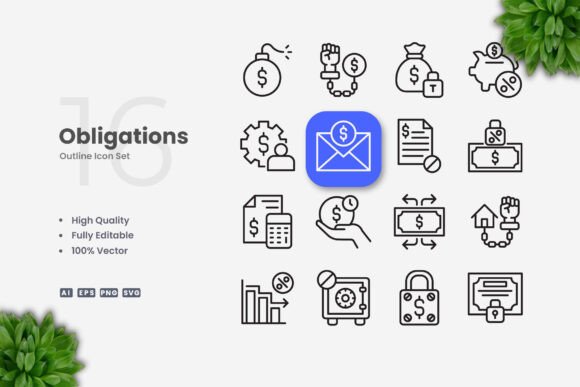
Obligations Icons is a curated set of vector symbols designed around the concept of tasks, commitments, responsibilities, and required actions. Think of a calendar alert, a checkmark inside a circle, a handshake, a gavel, a document with a signature line, a padlock, a bell, a clock with an exclamation mark. These are not decorative flourishes. They are functional signals that guide a user toward an action they need to take. And when you design something that asks a person to do something, the clarity of that visual matters deeply.
Where Obligations Icons Fit Into Real Projects
If you are building a mobile app that sends reminders for bill payments, you need an icon that says "due now" without needing a single word. A generic arrow or a vague circle will not cut it. A well-designed obligation icon with a simple bell and a red badge communicates urgency instantly. The same logic applies to a booking platform. When a user needs to confirm a reservation, a clean document icon with a checkmark removes ambiguity.
For websites, especially those that handle subscriptions, registrations, or legal agreements, obligation icons help users scan a page faster. People rarely read every word. They look for visual anchors. A handshake icon near a terms of service link tells the visitor that this is about agreement, not about some random page they can ignore. A lock icon next to a payment form reassures them that their obligation is protected.
Print materials often get overlooked when people think about icons, but flyers, banners, and posters rely heavily on visual shortcuts. A gym flyer with a calendar icon and the words "Sign up by Friday" works better than the same flyer with no icon at all. The icon creates a mental hook. It tells the viewer that there is a deadline, a commitment, a step they need to take.
Small business owners and freelancers
When you run a small business, you wear many hats. You send invoices, collect payments, schedule appointments, and manage contracts. Every one of those tasks can be supported by an obligation icon in your email template, invoicing software, or client portal. A simple icon of a document with a checkmark next to an overdue invoice changes the tone of the reminder. It becomes less about pressure and more about clarity. Freelancers who send proposals or contracts can use a signature icon to draw attention to where the client needs to sign. It reduces friction because the client sees exactly what is expected.
Marketers and bloggers
Marketers create landing pages, email campaigns, and social media graphics. A call-to-action button works harder when it is paired with an icon that reinforces the action. If you are promoting a free ebook download, a small arrow pointing downward inside a circle works. But if you are asking someone to register for a webinar, a calendar icon or a person icon with a plus sign communicates obligation more directly. Bloggers who create list posts or resource roundups can use obligation icons to separate actionable items from informational content. Readers appreciate knowing which steps they actually need to take.
Educators and course creators
Online courses often have modules that require assignments, quizzes, or milestone completions. An obligation icon set helps learners navigate these requirements quickly. A homework icon, a submission icon, a deadline icon, each one reduces cognitive load. Instead of reading through paragraphs of instructions, the student sees a visual cue and understands immediately that an action is expected. This is especially helpful for mobile learning environments where screen space is limited.
App developers and product designers
Product designers spend a lot of time thinking about user flow. Where does the user need to make a decision? Where do they need to confirm something? Where do they need to agree? Obligation icons can reduce drop-off rates because they make required actions visually distinct. A simple "accept terms" checkbox is more effective when accompanied by a document icon with a pen. A "confirm deletion" button with a warning triangle icon reduces accidental actions. These small details add up to a better user experience.
What Makes These Icons Practical for Everyday Use
The set comes in vector formats, which means you can resize them without losing quality. That matters more than most people realize. An icon that looks crisp on a phone screen might look blurry on a poster if it is a raster image. Vector icons stay sharp at any size. You can drop them into Adobe Illustrator, CorelDRAW, or any other vector software and adjust the stroke weight to match your design language. If your brand uses thin, minimal lines, you can reduce the stroke. If your project needs bold, readable icons, you can thicken them.
Color changes are straightforward. A single click can turn a black icon into a brand accent color. You can also create hover states, active states, or disabled states by adjusting the opacity or hue. For designers working on multiple versions of the same interface, this flexibility saves hours of work.
The PNG transparency files are useful for quick mockups or for people who do not use vector software regularly. You can drag and drop them into a presentation, a social media post, or a print layout without any technical steps. The readme file included in the package explains the folder structure, so you are not guessing which file does what.
Considerations Before Using Obligation Icons in Your Project
Not every icon set fits every context. Before you choose, think about the emotional tone of your project. Obligation icons carry a sense of responsibility. They are not playful in the same way that emoji or illustration-based icons might be. If your app or website is casual and entertainment-focused, you may want to pair these icons with softer colors or lighter stroke weights to avoid feeling too formal. On the other hand, if you are building a legal tool, a financial platform, or a healthcare appointment system, these icons reinforce trust and seriousness.
Stroke weight consistency matters. If you use multiple icons from the same set, they will already have a uniform look. But if you mix them with icons from another set, the difference in stroke weight becomes noticeable. Stick with one style per project to maintain visual harmony.
File format compatibility is something to check ahead of time. The source files include AI and EPS version 10, which open in most vector editors. If you use a less common tool like Affinity Designer or Inkscape, EPS should work, but it is worth testing early. SVG files are the most universal option for web use. They scale perfectly and can be styled with CSS if you embed them directly into your HTML.
Preview mockups are not included, which is standard for icon sets. You are buying the icons themselves, not the staged presentation. That is fine because your mockup should reflect your own project anyway. Drop the icons into your actual layout to see how they behave in context.
Realistic Scenarios Where These Icons Add Value
Imagine you are creating an infographic about tax deadlines. You have six steps, each with a short explanation. Instead of numbering them with plain digits, you use obligation icons: a calendar, a document, a calculator, a stamp, an envelope, a checkmark. The infographic becomes more engaging and easier to scan. People remember visual information longer than text alone.
Consider a banner for a community event that requires registration. A simple background with a bold headline works, but adding a registration icon with a person and a plus sign makes the call to action feel more urgent. The viewer does not need to wonder whether attendance is free or requires a sign-up. The icon tells them.
For a social media post promoting a limited-time offer, a clock icon with an exclamation point communicates scarcity without using aggressive language. It is subtle but effective. The same icon used in a mobile app notification signals that the user has a pending task. Consistency across platforms builds recognition over time.
In print materials like brochures or catalogs, obligation icons help organize information hierarchically. A section about payment terms can have a money icon. A section about shipping deadlines can have a truck icon with a clock. Readers who flip through quickly still pick up the structure.
Who Benefits Most From These Icons
Hobbyists who design their own printables or digital planners enjoy having a clean set of icons that they can customize. Entrepreneurs who outsource design work can hand over the icon set to their contractor with clear instructions on color and stroke preferences. Marketers who produce weekly content can reuse the same icons across different formats without starting from scratch each time. Bloggers who create resource pages or printable checklists can add visual breaks that keep readers engaged longer.
Anyone who has ever spent thirty minutes searching for the right icon knows the frustration of finding something close but not quite right. Obligation icons are specific enough to be useful, but general enough to adapt to many contexts. They do not try to be everything. They do one thing well, which is communicating that an action is expected or required.
That clarity is what makes them valuable. In a world full of visual noise, a simple, clean icon that tells someone what to do next is a small but meaningful help. Whether you are designing for a mobile app, a printed flyer, a website, or a social media graphic, the right icon at the right moment can make the difference between someone taking action or scrolling past.