Router Icons: Simple and Clean Design for Versatile Use
When you need to communicate connectivity, networking, or digital infrastructure in a visual way, a well-designed router icon can be one of the most effective assets in your toolkit. Whether you are building a website, designing a mobile app, creating an infographic, or preparing print materials, the right icon helps your audience instantly grasp the concept. But not all router icons are created equal, and many people end up with graphics that look unprofessional, scale poorly, or fail to communicate clearly. Let’s walk through the common pitfalls and practical ways to get the most out of simple, clean router icon designs.
Why router icons matter more than you think
Icons are not just decoration. They are functional pieces of visual language. A router icon, in particular, often appears in places where clarity is critical: network setup guides, Wi-fi instructions, device dashboards, or promotional materials for internet services. If the icon is overly complex, messy, or inconsistent with your overall design, it confuses rather than informs. A simple and clean router icon, on the other hand, works quietly and efficiently. It communicates “router,” “network,” or “connection” without forcing the viewer to decode unnecessary details. That is why many designers and creators deliberately choose vector-based router icons with editable strokes, customizable colors, and easy scalability.
Common mistake #1: Choosing raster over vector
One of the most frequent missteps is downloading a raster image format like JPEG or PNG when you need flexibility. Raster images are made of pixels, so when you resize them, you either lose quality or end up with a blurry, jagged mess. This is especially problematic if you plan to use the same router icon across multiple platforms: a small version on a mobile app, a larger one on a poster, and maybe a monochrome version in a book.
What to do instead: Always choose a vector format like SVG, AI, or EPS. Vector files use mathematical paths, so they scale infinitely without losing sharpness. A good router icon set will include source files in Ai (Adobe Illustrator) format, EPS version 10, and SVG. These files let you resize, change color, and edit stroke weight without any degradation. Even if you are not a professional designer, opening an SVG in a free tool or a vector editor gives you complete control.
Common mistake #2: Overlooking stroke weight and editability
Many people assume that once they download an icon, they are stuck with its appearance. That is not true if you choose a properly constructed vector set. Router icons with editable strokes allow you to adjust line thickness to match your brand or medium. For example, a thin stroke might look elegant on a high-resolution website, but the same stroke could disappear on a printed banner or a small mobile screen. If you cannot adjust the stroke weight, you lose that flexibility.
Practical advice: Before you purchase or download a router icon pack, verify that the stroke is editable. Look for a description that says “Editable Stroke” or “Customizable Stroke Weight.” In software like Adobe Illustrator or CorelDRAW, you can then select the icon and adjust the stroke thickness in seconds. This alone can save you from hours of frustration trying to fit a mismatched icon into your design.
Common mistake #3: Ignoring file variety
Another overlooked detail is the range of file formats included. You might only need an SVG for a website today, but next week you might need a PNG for a social media graphic or an EPS for a client’s print project. If you only have one format, you will have to convert it, and conversion often introduces problems like missing layers, broken strokes, or color shifts.
Better approach: Look for a set that includes multiple file types: source Ai file, EPS version 10, SVG, and PNG with transparency. Transparency is essential because router icons are often placed on colored backgrounds or layered over images. A white rectangle around your icon destroys the professional look immediately. The readme.txt file that comes with many sets will tell you exactly what is included and how to access each format. Take 30 seconds to read it before you start working.
Common mistake #4: Forgetting about color and consistency
You might find a router icon that looks great in black, but your brand uses a specific blue. If the icon is not customizable, you will either have to use a mismatched color or spend time recreating it from scratch. Many people settle for an icon that is “close enough,” and the small inconsistency weakens the overall visual identity.
How to avoid this: Choose an icon set that is 100% customizable. Vector files let you change the fill and stroke color to anything you need. You can also create multiple versions: a dark version for light backgrounds, a light version for dark backgrounds, and a brand-colored version for emphasis. Some professionals even create a monochrome version for accessibility or print scenarios where color is limited. With editable vector files, you can do all of this in a few clicks.
Common mistake #5: Misunderstanding print versus screen needs
An icon that looks crisp on a retina display may look fuzzy or too thin when printed. Conversely, an icon designed for print may appear heavy and clunky on a website. This is a classic problem that even experienced creators encounter.
Solution: Since your router icon set includes vector source files, you can adjust the design for each medium. For print, you might want a solid, slightly heavier stroke and a simpler silhouette to avoid ink bleeding. For screens, you can use thinner strokes and more detail because pixel density is higher. The ability to edit stroke weight and color per output is a huge advantage. If you are designing for both, create a master file and then make medium-specific copies.
Common mistake #6: Rushing the download without checking the license
It is easy to click “download” without reading the terms, but licensing matters. Some free icon sets restrict commercial use, require attribution, or limit the number of projects you can use them in. If you are a freelancer, small business owner, or entrepreneur, you cannot afford legal ambiguity.
Check this first: Look for an explicit statement about commercial use, modification rights, and redistribution. Many premium sets are licensed for unlimited use across personal and commercial projects. If the license is unclear, contact the creator or choose a different set. The readme.txt file often includes license details, so do not skip it.
Common mistake #7: Forgetting about context and scale
A router icon might look great on its own, but how does it work in context? Some icons have too many internal details that become noise when scaled down. Others are so minimal that they do not read as a router at all.
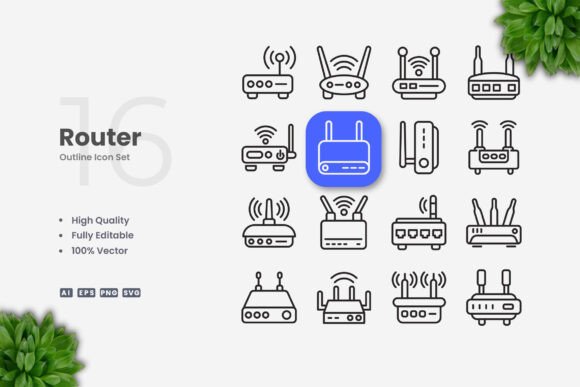
Practical tip: Test the icon at multiple sizes before committing. Place it in a mockup of your website, app screen, or flyer. If the router symbol becomes unclear at small sizes, consider a simpler variant. Many vector sets include multiple versions of the same icon, so you can choose the one that works best for each application. The preview image in the set is helpful, but testing in your actual layout is the only real way to know.
Common mistake #8: Ignoring the value of source files
Some people only download PNG or SVG and think that is enough. But if you ever need to make a global change—like updating the stroke weight for a entire series of icons—you will want the original source file. Without it, you have to edit each icon individually, which is tedious and error-prone.
Why source files matter: The Ai source file preserves layers, groups, and editable paths. You can open it in Adobe Illustrator or CorelDRAW and modify multiple icons at once using global edits. This is especially useful if you are working with a set of networking icons and need consistent styling across all of them. Source files also make it easier to export to any format you need later.
How to get the most out of your router icons
Once you have chosen a high-quality, customizable vector set, here are a few practical steps to maximize its value:
- Organize your files: Keep the Ai, EPS, SVG, and PNG files in a folder with the readme.txt. Name them clearly so you can find the right variant quickly.
- Create a brand palette: Before editing, define your color palette and stroke weight range. Apply these consistently to all icons you use.
- Test on real backgrounds: Place the icon on light, dark, and textured backgrounds to ensure it remains legible.
- Keep a master file: Save a layered master file in Ai or EPS that you can return to for future edits.
- Use PNG transparency properly: When exporting for web or social media, make sure the background is transparent and the icon is positioned correctly within the canvas.
What to look for in a router icon set
If you are shopping for a router icon set or evaluating one you already have, here is a quick checklist:
- Vector format: Includes SVG, Ai, EPS. Avoid sets that only offer raster.
- Editable stroke: You can change thickness without redrawing.
- Customizable color: Fill and stroke colors are easy to modify.
- Multiple file types: Source Ai, EPS 10, SVG, PNG with transparency.
- Readme.txt: Clear instructions and license info.
- Scalable design: Icon reads well at both small and large sizes.
Final thoughts
Router icons are small but powerful tools. When they are simple, clean, and built on vector paths, they save you time, reduce frustration, and help your work look professional across all mediums. The mistakes described here are common, but they are also easy to avoid with a little forethought. Whether you are a blogger creating an infographic about home networks, a marketer designing a banner for an internet provider, or an educator developing a visual guide, the right router icon set will serve you well for years. Take a moment to check the file formats, verify editability, and test the icon in your actual layout. That small investment of attention will make your final work stronger and more reliable.