Onion Icons – Clean Vector Icons for Modern Design Projects
Every designer knows the feeling: you have a layout that works, colors that sing, and type that reads beautifully—but something still feels off. More often than not, the missing piece is a set of icons that matches the clarity and polish of everything else. That is exactly where Onion Icons steps in. Built around a simple and clean icon design philosophy, this set delivers exactly what busy creatives need: versatile, editable vector graphics that work from the first sketch to final export.
What Makes Onion Icons Different from Standard Icon Sets
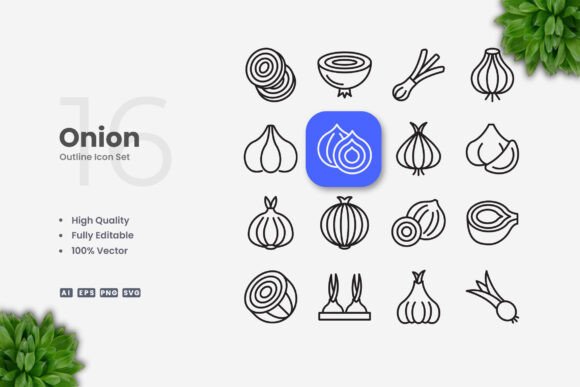
Onion Icons is not one of those bloated collections where you spend more time searching than using. It focuses on deliberate, minimalist forms that carry meaning without unnecessary decoration. Each icon has a consistent stroke weight, balanced proportion, and a neutral visual tone that fits comfortably into both modern and classic layouts. The style is straightforward—no overly trendy flourishes, no exaggerated perspectives, just solid, functional iconography.
The personality here is calm and professional. These icons do not shout for attention; they support your content, guide the eye, and reinforce your message without competing with it. Whether you place them next to a headline, inside a button, or as a standalone visual on a poster, they hold their own without feeling heavy or clumsy. That is a harder balance to strike than most people realize, and it is one of the reasons designers keep coming back to this set.
Where Onion Icons Shines Across Projects and Platforms
Versatility is the whole point. Because Onion Icons avoids hyper-specific styling, it adapts naturally to almost any medium you throw at it. Here are some of the real-world scenarios where it performs especially well:
- Websites and mobile apps – The clean lines render crisply on screens of every size, and the simple shapes remain recognizable even at smaller scales. Navigation icons, feature highlights, and call-to-action buttons all benefit from the consistent visual language.
- Books and editorial layouts – Print projects demand clarity, especially at small sizes. Onion Icons holds up well in margins, pull quotes, chapter headings, and infographic callouts without overwhelming the text.
- Social media graphics and infographics – When your audience scrolls fast, every pixel matters. Icons that are simple to parse at a glance help viewers understand your point before they even read the caption. That is exactly what you get here.
- Flyers, banners, and posters – Large-format print needs icons that scale without losing edge sharpness or becoming pixelated. Since these are fully vector, you can blow them up to billboard size and they will still look clean.
- Brand identity and presentation decks – Consistency across every touchpoint builds trust. Using the same icon style in your pitch deck, website, and printed collateral signals that your brand pays attention to detail.
How Onion Icons Influences Readability, Hierarchy, and Brand Perception
Icons are not just decoration. They actively shape how people interact with your content. When you place an icon next to a block of text, you are creating a visual anchor that tells the reader where to look first. With Onion Icons, the simplicity of the design means the icon never fights the text for attention. Instead, it creates a clear entry point into the information.
From a brand perspective, using a cohesive icon set like this one signals professionalism. Randomly mixing icon styles from different sources is one of the fastest ways to make a design look disjointed. Onion Icons gives you a single visual vocabulary across everything you produce. That consistency builds recognition over time—people start associating that clean, uncluttered look with your brand specifically.
There is also the question of audience engagement. Icons that are easy to interpret reduce cognitive load. Visitors to your site or readers of your brochure do not have to pause and wonder what a symbol means. They process it instantly and move on to your message. That frictionless experience keeps people engaged longer and makes your content feel more accessible.
Practical Guidance for Choosing and Using Onion Icons
Before you start dropping icons everywhere, it is worth thinking about fit. Onion Icons works best in projects where clarity and simplicity are priorities. If your brand identity leans toward minimalism, modernism, or clean corporate aesthetics, this set will integrate seamlessly. If your project calls for highly decorative or illustrative iconography—think hand-drawn textures or ornate line work—you might look elsewhere. Know the mood you are trying to set, and let that guide your choice.
Testing pairings is also part of the process. Onion Icons pairs naturally with sans serif fonts like Open Sans, Lato, or Montserrat because both share that straightforward, readable quality. It also works surprisingly well with neutral serif fonts for editorial projects where you want a touch of contrast between traditional type and modern icons. The key is to keep the overall tone uncluttered. If your typeface is already bold or ornate, a simpler icon might provide balance.
When it comes to evaluating the set itself, take stock of what you actually need. Onion Icons includes 100 vector icons, all fully customizable. The files come as AI, EPS 10, SVG, and PNG with transparency. That range covers most workflows. You can open the source files in Adobe Illustrator or CorelDRAW, resize without quality loss, change colors to match your palette, and adjust stroke weight if you need a bolder or lighter look. The drag-and-drop setup makes it easy to pull icons directly into your working file without fuss.
Readability is another practical consideration. Test your icons at the actual sizes they will appear. What looks clear at 100% zoom on your monitor might lose definition at 24 pixels on a mobile screen or 8 point in a printed booklet. Because Onion Icons is built with clean, open shapes, it generally holds up well at small sizes, but it never hurts to preview in context.
On the licensing side, this is a commercial set. That means you can use it in client work, branded materials, products for sale, and marketing campaigns without worrying about attribution or usage caps. Always double-check the specific license terms included in your download, but the standard offering here is straightforward for both personal and commercial projects.
Real-World Workflow Tips from Experience
If you are new to working with vector icon sets, here is a short workflow that saves time. Start by opening the SVG or AI file in your preferred vector software. Group or ungroup elements as needed—these icons are usually delivered in organized layers. Pick a master color or two from your brand palette and apply them across the board. If you need different stroke weights for different contexts, adjust globally rather than icon by icon. That keeps the set feeling unified even when you use it across multiple layouts.
For web and app work, SVG is your best friend. It is lightweight, scales perfectly, and can be styled with CSS if you want hover effects or color changes on the fly. For print, PNG with transparency works well for quick placements, but vector formats give you the most control over output quality. Keep the AI or EPS master file handy as your single source of truth, and generate PNG exports only when you need them.
Another practical tip: when you are designing social media templates or presentation decks, create an icon library page inside your working file. Paste all the Onion Icons you plan to use onto a single hidden layer or artboard. That way, you can copy and paste them into different layouts without digging through folders every time. It is a small organizational habit that pays off fast when deadlines are tight.
Bringing It All Together
Onion Icons is not trying to reinvent icon design. It is doing something arguably more useful: delivering reliable, well-crafted vector icons that work where you need them, how you need them. The clean style fits a wide range of projects, the editing flexibility puts control back in your hands, and the format choices ensure you are covered whether your final output is digital or print. For designers, marketers, and small business owners who want consistency without complexity, this set earns its place in the toolkit.